
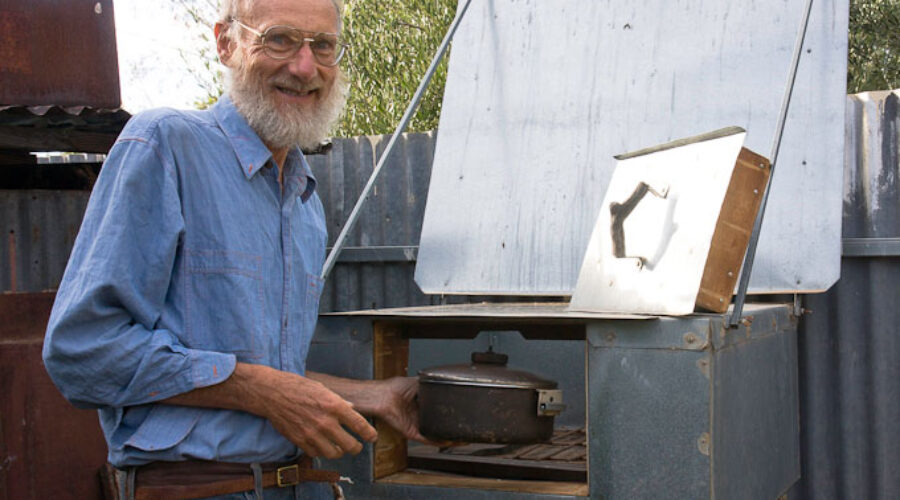
Sun the energy source for evening meals at Selli-Hoo
HERE’s a solar oven that’s been cooking for decades.
It’s the handiwork of the people at what is probably Australia’s longest-running share house—Selli Hoo, in Adelaide—Selli-Hoo has been operating for over 30 years now.
I’ve had the good fortune to stay at Selli-Hoo a number of times when in Adelaide and find the place convivial, welcoming and inspirational.
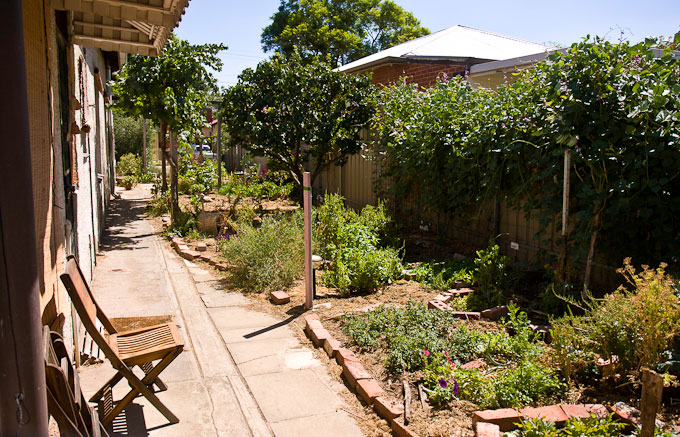
A few things about Selli-Hoo… this is a bicycle house, none of the residents own a car and the long driveway from the street to what was once the garage was a long time ago turned into a vegetable garden. And the garage? It’s a workshop—you notice the home made solar hot water array on the roof as you walk past herb and fruit tree along the once-was-a-driveway—and in it the residents have made some of the bicycles you see suspended below the grape vine-covered trellis… road bikes, cargo bikes… you name it and it’s there if it can be made with two wheels, one behind the other.
Keep walking and you come to the chook pen where a big black bird struts among its companions and where I watched as a chook swooped at a passing mouse… and swallowed it whole. Amazing things are to be seen at Selli-Hoo.
Go a little further are find a few fruit trees, and, off to the side, a pise hut the orange colour of the earth. This too is home made. These are industrious people.
Inside what was once a single storey and quite large house, there’s a living room, a couple bathrooms, a room or two kept for renters and the rooms of the permanent owner-residents.
The kitchen is a welcoming place, as kitchens should be, because here, too, it is the heart of the house and its little community. The community tries to cook and eat together at least weekly and the food here is of the wholesome, basic variety some of which you see in the jars of grains and pasta and other ingredients that line one of the walls. And the source of that food? Much of the fresh herbs and veges come from the garden in what-was-once-a-driveway. Dry goods come from the Clarence Park Food Co-op, another institution close to Selli-Hoo in location and age that opens Thursday evenings at the nearby community centre, where the goods are also stored. Extras come from the Adelaide markets on Saturdays.
There are signs on invention and adaptation everywhere. Even at the entrance, next to the laundry (they make their own washing preparation), a couple bicycles hang upside down from hooks in the ceiling. Down the passageway are storage shelves. Look out the western windows and you see a long trellis along the side of the house with a shade-casting grape vine covering it, something appreciated in Adelaide’s Mediterranean climate with its hot, dry summers.
Caring for people
All of this self-built infrastructure and the longevity of the household wouldn’t have been possible without maintaining good relations between people over the years. Surprisingly, this is not a rule-laden household and much depends on good, mature common sense. Regular informal meetings keep things on track and demonstrate the importance of communication in a shared residence.
But is this a model for affordable housing for people with few possession and a willingness to share in household management? The fact of Selli-Hoo’s longevity is testament to the veracity of the model. Clearly, though, this is an arrangement far from everyone’s taste because living here requires a cooperative mentality and the ability to live without heaps of possessions. All of what people need in a household, beyond personal belongings, is already present in the house. But… and this is a big, positive but, this is the means to security of tenure for those willing to live the life… a means to affordable accommodation.
Time to cook-up
It’s around midday now and Ashley is spooning a mixture of grains into a large cast iron pot. Satisfied with his measure, he puts a lid on it and walks out into the backyard where Adelaide’s fierce sun beats down. Past the pise structure, he comes to a large metal box with a little window cut into the front. Lifting the hinged lid—it’s covered with a shiny material that reflects light into the box—you notice a perspex cover on top of the box and a thermometer inside, close to where he places the pot and then closes the door. By dinner time, the solar cooker will have almost cooked the grains and goodies in the pot.
Selli-Hoo—it’s simple living made possible by a thoughtful complexity of good relations, appropriate technology and the imagination of good people.
EF Schumacher would have been proud.
