Sign In
  • Log In
  • Register

Lost Your Password?

Registration is disabled

PacificEdge
  • Home
  • About
    • About PacificEdge
    • Get in touch
  • Blog
  • Journalism
    • PacificEdge on Medium
    • Permaculture journal on Medium
    • By Road & Track on Medium
    • Citizen journalism
    • Journal
    • Nomadics
    • The alt.food movement
    • A Tasmanian journey
    • Memoir
  • Permaculture
    • PERMACULTURE journal — Medium feed
    • Permaculture Papers
    • The Trainer Papers
    • Participatory techniques
  • Publications
    • PacificEdge papers
    • Policy related documents
    • TerraCircle publications
    • Storehouse photo essays
    • Adobe Spark photo essays
PacificEdge
  • Home
  • About
    • About PacificEdge
    • Get in touch
  • Blog
  • Journalism
    • PacificEdge on Medium
    • Permaculture journal on Medium
    • By Road & Track on Medium
    • Citizen journalism
    • Journal
    • Nomadics
    • The alt.food movement
    • A Tasmanian journey
    • Memoir
  • Permaculture
    • PERMACULTURE journal — Medium feed
    • Permaculture Papers
    • The Trainer Papers
    • Participatory techniques
  • Publications
    • PacificEdge papers
    • Policy related documents
    • TerraCircle publications
    • Storehouse photo essays
    • Adobe Spark photo essays
Sign In Add Listing
Jerusalem artichoke

Jerusalem artichoke

  • June 1, 2025February 8, 2026
  • Edible roots

Photo and story by Russ Grayson

Common name: Jerusalem artichoke (less common in Australia: sunroot, sunchoke — a commercial name dating from the 1900s).

Botanic name: Helianthus tuberosus

Plant family: Asteraceae
(so named because flowers radiate from a central point to make a star-like shape. ‘Aster’ is Latin for ‘star’).

Centre of diversity: North America.
Uses: Food.
Growth form: Long-stemmed annual to around 1.5m with foliage coming off a central stem. 
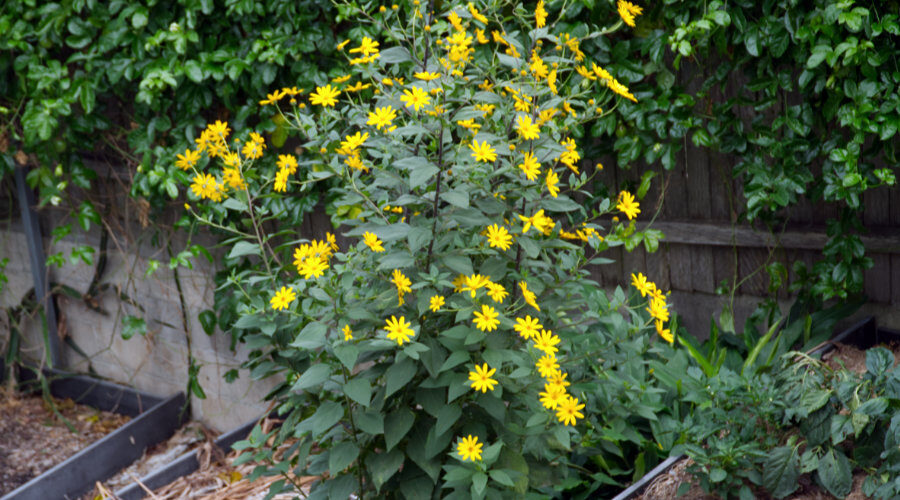
A temperate region crop, the plant is a member of the sunflower family and in autumn produces bright yellow flowers that are smaller than those of the sunflower although otherwise similar in form.
Ready for harvest in the cool season, Jerusalem artichoke is harvested when the leaves brown and fall and when the stem dries and browns.

Reproduction: From tuber or part of tuber. Tubers will regenerate if left in the ground.

Rotational cropping into fertile garden beds will maintain the quality of the tubers which, if left to regrow in a single location, will degrade over successive crops.
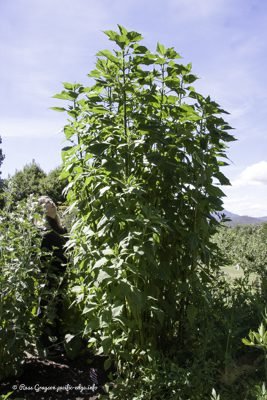
Jerusalum artichoke has a similar growth form to sunflower. It can grow in excess of two metres.

Edible part: The tuber, which is cooked. 

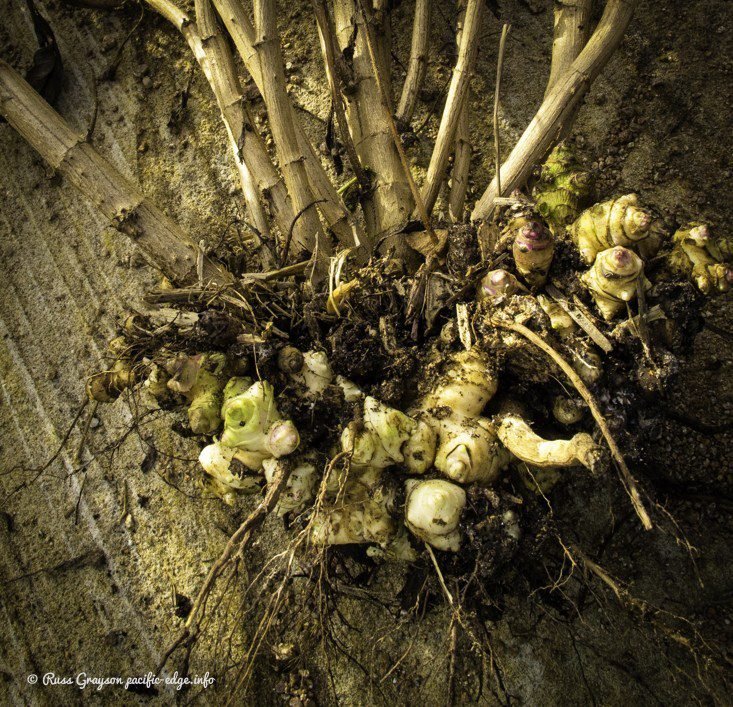
Tubers are variable in size, commonly around 7-10cm long and 3–5cm thick and commonly off-white or light brown.

Tubers are best left in soil storage until required for cooking. They will last some time before sprouting to start the next generation of plants.

Uses in community food garden design: Root crops provide much nutrition and planting a number of species including Jerusalum artichoke can increase a family’s food security through the year.

  • plant in annual cropping beds
  • protect from string winds.
Once the leaves fall and stems brown, Jerusalum artichoke is ready for harvest. The cluster of edible tubers is seen in the root mass.

Notes: Native Americans cultivated the plant for food before the arrival of Europeans. European settlers sent tubers back to Europe where they were commercially cultivated.

The Jerusalem artichoke has no relationship with the city of Jerusalem, the name being perhaps a corruption for the Italian name for sunflower. Nor is it an artichoke, the name believed to be attributable to a European explorer noting a similarity in taste to artichoke. 
Wikipedia entry

  • Share
  • Share
  • Pin

Post navigation

Previous Post French sorrel
Next Post Bananas

Leave a Reply

Your email address will not be published. Required fields are marked *

This site uses Akismet to reduce spam. Learn how your comment data is processed.

Contact us… Russ Grayson

View Profile

Journalist & photographer with media, international development and adventure equipment background. Media, adventure activities, writing, permaculture.

Send Message

Connect with us

Latest stories

  • Test blog posting
    July 18, 2026
  • Babaco — bit like a pawpaw but not quite
    June 1, 2025
  • Pawpaw — another fast fruit
    June 1, 2025
  • Black sapote — chocolate pudding fruit
    June 1, 2025
  • Bananas
    June 1, 2025

Journalist & photographer with media, international development and adventure equipment background. Media, adventure activities, writing, permaculture.

Visit my Medium site

Blogs:

  • PERMACULTURE journal
  • PacificEdge

Helpful Links

  • About PacificEdge
  • Get in touch
  • My Profile
© PacificEdge 2026
Hi! How can I help you?
AI Assistant
Expand chat Collapse chat
Start a new chat
Powered by PurioChat