
Babaco — bit like a pawpaw but not quite
Photos and story by Russ Grayson
Easy to grow, likes water but not too much, tasty.
Common name: Babaco
Botanical name: Carica pentagona
Growth form/conditions: A slender, uptight plant of compact growth form like pawpaw. Single, softwood trunk patterned with leaf scars. Seldom grows more than two metres in height.
A plant of the tropics, subtropics that grows in Sydney’s coastal warm temperate climate.
Irrigation is essential during growth for this soft-trunked plant. It can be damaged by frost.
Root rot, resulting from poorly draining soils, and insects like the two-spotted mite can damage the plant and need to be monitored.
Reproduction: Babaco is a natural hybrid of the pawpaw. It produces only female flowers but no seed.
To propagate, the trunk is cut into short lengths and propagated in a well-drained, sandy growing medium until ready for transplanting.
Centre of diversity: Ecuador. A plant of the rainforest.
Uses: Food.
Edible part: Fruit.
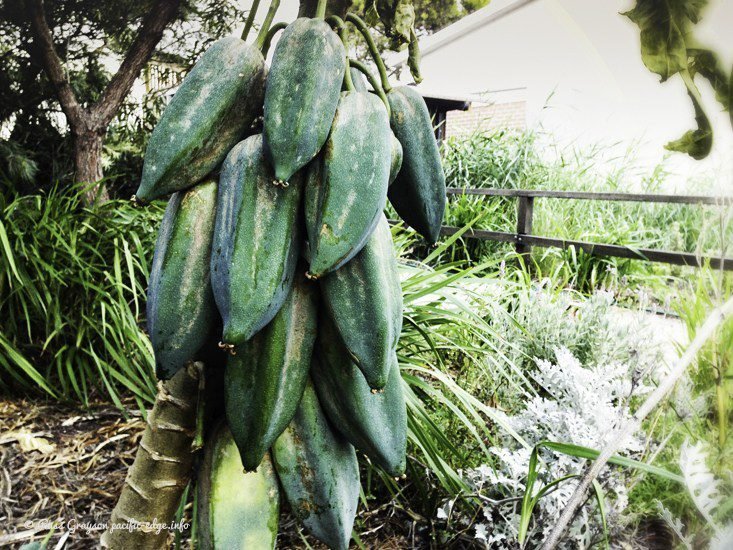
The fruit grows in a cluster from the upper trunk and takes the form of an angled, elongated pawpaw-looking fruit that starts green and yellows as it ripens. The pale-coloured flesh has a slightly acid, juicy flavour and is eaten raw.
Fruit can be left to yellow and ripen on the plant, however picked fruit selected as ripening is underway will also ripen. It is not unknown for fruit to fall from the trunk and bruise.
Babaco can produce between 30 to 60 fruits annually when planted in a warm, sheltered microclimate with protection from wind, and is given sufficient water and compost. As a fast fruit — fast growing and fast fruiting — babaco completes its lifecycle within five or so years.
Uses in food garden design:
Babaco takes little space in the community garden and casts only limited shade.
Like the pawpaw to which it is related, babaco can be grown as a clump of plants. Doing this provides some protection from wind damage, however it is a plant that benefits by being grown in a wind-protected part of the garden.
Plant sufficient babaco to supply the number of people in your community garden plus a few extra to allow for the failure of individual plants. Babaco can be ordered from nurseries specialising in fruit trees and shrubs.
Notes: If you live in a cool microclimate in the subtropics or even as far south as Sydney or the south-west of Western Australia, babaco is an easy-to-grow fast fruit for your community garden or city farm.
For community gardeners in the marginal subtropics, babaco will grow at higher and cooler altitudes than pawpaw, making it the most cold-tolerant plant in its genus. It is tolerant of light to medium shade.
In the community garden, protect the babaco copse from hostile winds by planting hardier, wind-tolerant plants to windward to form a windbreak. Babaco is one of the fast-fruits that yield food within a couple of years.
