
A beach, wild harvest and a reptile
Story, photo and videos by Russ Grayson, December 2023
It was Jo Dean’s idea to take an early morning walk along the foreshore track. “Good idea,” I said. So shoes and hat on and off we go.
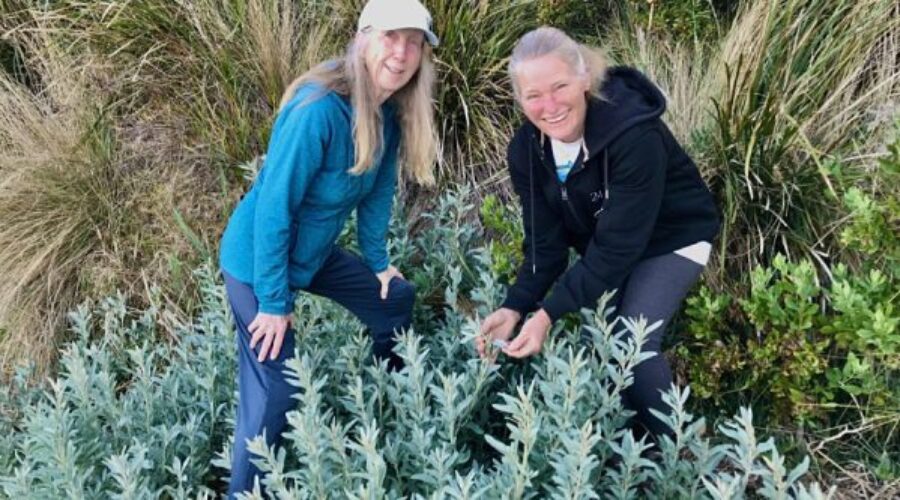
The foreshore track is an informal trail along the water’s edge. The tide was out so we set off walking along the tidal sand flats, crossed China Creek and continued to the boat sheds at the far end of the beach. We stopped to take a look at a saltbush growing on the foreshore.
Saltbush — a useful plant
“This is a useful plant,” I remarked as Jo bent down to look at the silvery-grey foliage. Being a woman knowledgeable about nature and plants—she is also a permaculture educator and Tasmanian coordinator of the national organisation, Community Gardens Australia—she already knew about saltbush and could have taught me a thing or two, like how she prepares it.
“I dry the leaves then grind them to use as a salt substitute”, Jo explained.
“I think you can eat them raw.” That was Fiona, who plucked a leaf and bit off a small portion. “Very salty.” Fiona is Community Gardens Australia’s website manager.
It was a calm and fine morning. The sea reflected the blue of the sky. With the temperature already at 16°, a warm day was in the offering. That’s when I saw it.
Read more about Saltbush, a post by Russ Grayson.
A little whippie
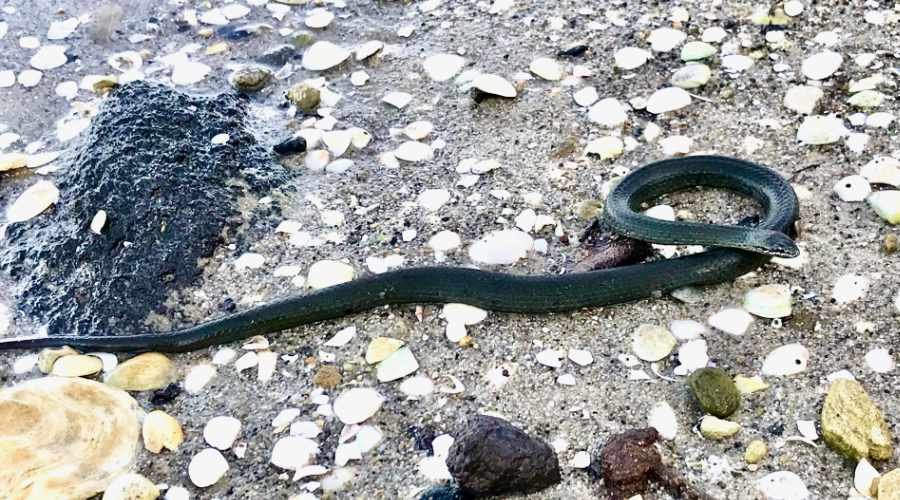
“Oh look”, I said. “A little whippie”
“Ah, yes”, Jo responded as she looked at the creature. “I’ve never seen one in the seawater before.” But, there it was where the water lapped the sandy shore, its head raised and watching us as we watched it.
“Don’t get too close Russ”, Fiona warned as I crouched down to get photos of the reptile.
Also known as the white-lipped snake (Drysdalia coronoides) because of the white markings on its upper jaw, the whip snake grows to 40cm and is the smallest of Tasmania’s danger noodles. A hunter, it feeds on skinks and frogs and is fed upon by an introduced bird, the kookaburra.
Here in Tasmania, there is no need to worry about which of our snakes are venomous. They all are. The copperhead and tiger are Tasmania’s other two species, both much larger than the whippie. Snakes are occasionally found in community gardens abutting bushland. That is why a first aid kit with snakebite bandages are recommended for all community gardens, plus the knowledge of how to use the kit.
With Jo having to get to a meeting of 24 Carrot, the organisation she works with in school garden outdoor classrooms, it was time to head back.
Pigface — another useful plant
On the way we talked about how people sometimes overharvest the wild harvest, like the saltbush and edible pig face we stopped to look at, and how they should take only a little to leave some for others, for the wildlife and for the plant, too. Better still, plant your own at home or in your community garden. In community gardens, saltbush and pig face belong in the fruit tree area, along fences away from the annual vegetable beds or in less-visited locations because they are low-maintenance native plants.
So, saltbush, pigface, a reptile on the beach and a pleasant stroll and conversation. Surely there is no better way to start the day.
Read more about Pigface, a post by Russ Grayson
